

THE TIME JEWEL
The Time Jewel, known in other cultures as the Time Crystal or the Time Gem, is a sentient artifact that holds together the fabric of time itself. Similar to the Time Stones, the Time Jewel also chooses its champion, though in a different way. There is only one Time Jewel, and it connects to the Time Stone hivemind as the mother of all Time Stones.
OVERVIEW
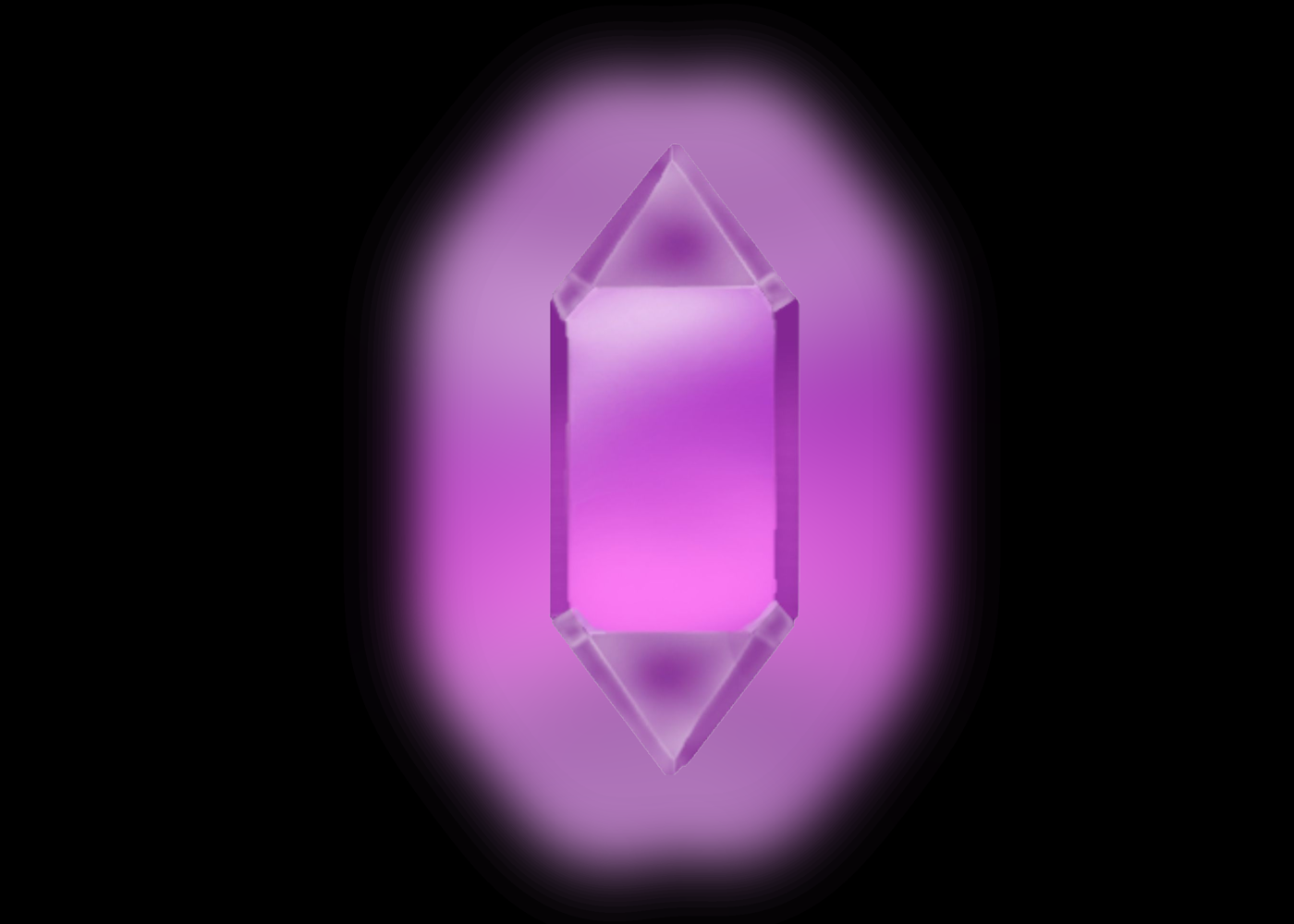
The Time Jewel appears as a crystal that emits a purple glow. It is about twelve centimeters tall and five centimeters wide.
The Time Jewel is the primary pillar of time. It holds together and regulates the fabric of time, while the Time Stones regulate it.
The Time Jewel behaves similarly to the Time Stones. When left untouched by a living multicellular being, it goes into a state of hibernation. There is no known way to wake it from hibernation except by bringing it into close proximity to a Time Stone and having a Stonewielder touch it. When awakened, it connects to the Time Stone hivemind as the mother of all Time Stones.
Similarly to the Time Stones, the Time Jewel also picks its champions, known as Jewelwielders or Timewatchers. However, it does so in a much stricter way than the Time Stones, though its criteria are totally unknown due to a lack of formal experimentation.
PROPERTIES
The abilities it grants its champions are not fully known, but Time Stone scholars have hypothesized that it produces the same effects as the Time Stones, amplified by its sheer power. Its most well-known and only widely tested ability is its life-giving properties.
The Time Jewel could heal people and keep some alive past the age of one hundred. It could also grow crops and make plants grow very fruitfully, even in the harsh winters of what is now known as Ajkalsk. However, little else is known.
KNOWN HISTORY
Theories about the Time Jewel’s origin are bunched together alongside the Time Stones’. In the Meteorite Theory, it is hypothesized to have been the core of the meteorite, while the Creationist Theory argues against it.
The Time Jewel remained in a single location for hundreds of years, which is the city now known as Ajkalsk, situated in the northern half of the Komi Republic within Russia. The village was settled at around the fourth century, being named Ajkalu, which roughly translated to Ancestor’s cradle. By the sixth century, the local village people discovered the existence of the artifact.
The existence of this mysterious relic brought prosperity to the village and helped it turn into a town. It did the impossible, allowing the villagers to grow very fruitful crops in even the harshest of winter when in close proximity to it. It eventually became integrated into the local myths, being called the Dyr yi, meaning Time Ice.
For hundreds of years, the Dyr yi stayed in the village, allowing the town to prosper and develop more so than the other villages all around the region. In the fourteenth century, Russian explorers began venturing into Siberia, stumbling into the bustling developed town of Ajkalu. The Moscovite explorers documented the town’s history, culture, and most importantly, the Dyr yi. Upon encountering the mythical relic, the explorers called it the Time Crystal.
When the Grand Duchy of Moscow fully colonized the region in the fifteenth century, all local towns and cities had to be Russified as part of the forced assimilation process. This led to the town of Ajkalu being renamed to Ajkalsk. The Time Crystal was able to remain in the town as part of its tradition to quell civil unrest. A bureaucratic mistranslation ended up making the Time Crystal’s official name Time Jewel. This became what the rest of the world called it.
Upon hearing about the Time Jewel’s existence in the latter half of the sixteenth century, the Azalia Global Time Council sent scholars specialized in Time Stone studies to figure out what it was. Upon figuring out it was more powerful than all the Time Stones, they had to decide its fate. Ultimately, the AGTC decided to allow the Ajkalsk townsfolk to keep the Time Jewel as long as they abide by the Azalia Accords of 1574, not wanting to cause any more tensions between Central Europe and the newly formed Tsardom of Russia.
For the next few hundred years, Ajkalsk was able to develop into becoming a city.
During the Russian Revolution in 1919, the Russian Bolsheviks were able to take the town of Ajkalsk from the Russian whites. The AGTC immediately declared a state of emergency, fearing for what the Bolsheviks would do to the Time Jewel. So, the AGTC temporarily allied with the Entente and invaded Ajkalsk through the Arctic Ocean. When the Time Jewel was taken, the expeditionary force departed, leaving behind an Ajkalsk destroyed by fighting. After a brief diplomatic crisis, the AGTC allowed France to keep the Time Jewel within a museum
After the German Reich’s invasion of France in 1940, the Time Jewel was not able to be evacuated in time. The Germans experimented with it, then attempted to throw away the German Stonewielders into the Soviet-German frontlines by 1942. However, one of the Stonewielders survived, teaming up with the Soviet Ukrainian Stonewielder and a group of other Stonewielders to organize a heist to steal back the Time Jewel.
The Stonewielders managed to steal back the powerful artifact before the Germans could further experiment on it. However, instead of giving it the AGTC, the Soviet Ukrainian Stonewielder hid the Time Jewel in a random lake within Siberia.
In 2024, the Time Jewel was found in the middle of a lake in
Ajkalsk.